
Why Rainwater Harvesting Is Key to Every Sustainable Garden


For his entire career, our designer David has talked much about sustainable gardening in terms of plants: drought-tolerant palettes, native and non-native species, pollinator-friendly borders… All of that still matters, of course, but it’s not where sustainability really begins.
It begins with water.
Having designed many gardens across drastically different terrains and client expectations (and having a handful of those gardens recognised with industry awards internationally), we can say with confidence that a garden cannot be 100% sustainable if it relies too heavily on mains water. At least not anymore, not in the climate we’re designing for today.
Rainwater harvesting is now the foundation of responsible, future-proof garden design, and we’re here to get into it.
The Uncomfortable Truth About Mains Water
Mains water in the UK was never intended for gardens. It’s treated to drinking-water standards, pumped across long distances, energy-intensive to produce and increasingly scarce. Using it to irrigate ornamental planting, lawns and borders made sense in a different era, when rainfall was predictable and supply was abundant. But that era is over.
We now design for a world of longer droughts, heavier downpours, hosepipe bans, rising water bills and mounting pressure on infrastructure. Continuing to irrigate gardens with mains water in this context is as expensive as it is environmentally illogical.
Meanwhile, rainwater is free, abundant (often arriving all at once) and perfectly suited to plants… but it’s also a gift we’ve forgotten how to receive, usually wasted. The thing is, every roof already collects it and every garden already sheds it. The real question is whether we design systems to capture and use it, or let it run down a drain.
The Real Benefits of Rainwater Harvesting
When incorporated with rainwater harvesting, a garden stops being a passive consumer of precious resources and starts behaving like a system, because rainwater harvesting:
Reduces or even eliminates reliance on mains water
Makes gardens more resilient during droughts and restrictions
Improves plant health (rainwater is softer and chemical-free)
Encourages better soil design and water retention
Forces more thoughtful, site-responsive layouts
Most importantly, it shifts the way we think about water. Instead of asking, “How do we water this garden?” You ask, “How does this garden manage water?” And that should be the mindset behind every truly sustainable garden.

How to Design Rainwater Harvesting Into Your Garden
One of the biggest misconceptions I encounter is that rainwater harvesting is restrictive and/or ugly. In reality, when it’s designed properly, it becomes an integral part of the garden.
Here are some of the ways I’d recommend implementing it in your garden design projects:
1. Storage That’s Planned, Not Hidden
In my own projects, I plan water storage as a design element, not something to hide away behind a shed. Tanks can be clad in timber or metal to echo architectural materials, integrated into retaining walls or raised planters, or even positioned as sculptural features in contemporary gardens.
When storage is considered early in the design process, it enhances the overall aesthetic rather than detracts it.
2. Incorporating Gravity-Fed Systems
Wherever possible, I like to work with gravity rather than against it. Raised tanks, subtle changes in level, and carefully considered water routes allow rainwater to move through the garden with minimal energy input. Gravity-fed irrigation is quiet, efficient and resilient.
Not to mention there are no pumps to maintain, which means no unnecessary complexity, perfect for any client who feels that rainwater harvesting might be over-engineered—more on this below.
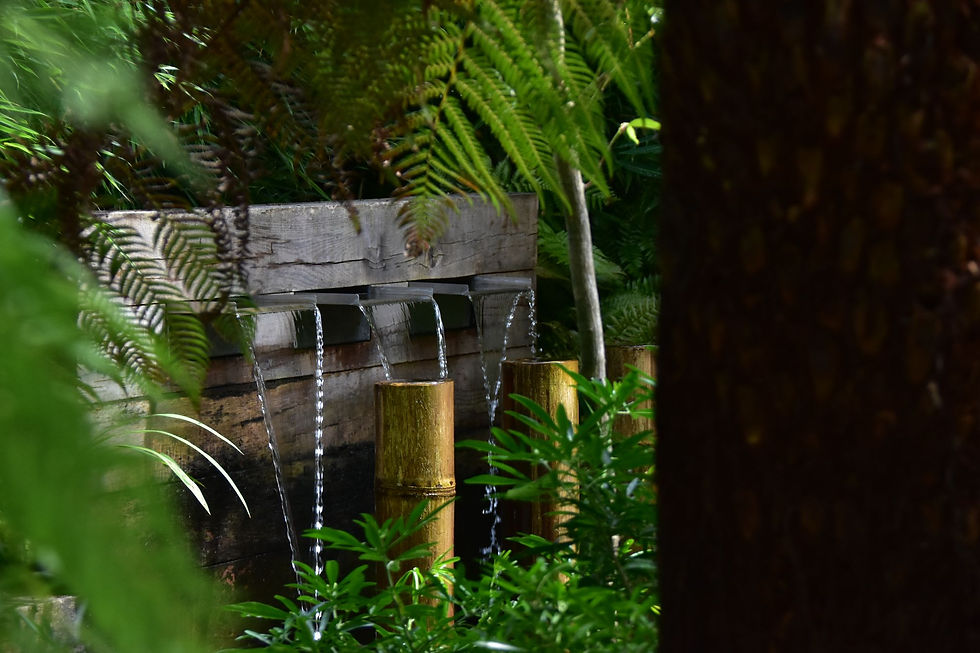
3. Linking Harvesting to Planting Design
Effective rainwater harvesting only works when it’s designed alongside the planting scheme.
Deep, organic-rich soils, well-mulched beds and plants that can cope with variable moisture all play a crucial role. This is why thoughtful design matters, because the water system and the planting must be conceived together. When they are, the garden becomes more resilient, lower maintenance and far better adapted to its climate.
Common Concerns About Rainwater Harvesting—and My Honest Responses
Despite its growing awareness and proven benefits, I still hear the same concerns regarding rainwater harvesting from my clients. Here are some of the most common pushbacks I get and how I address them:
1. “We don’t get enough rain for it to be worth it.”
As far as North West England is concerned, we get way more rain than necessary, though it may not always arrive on a predictable schedule. Even if your area receives only modest rainfall, if captured consistently, it can dramatically reduce your mains water use. I always reiterate to my clients that the goal isn’t total independence but reduced dependence.
2. “Water tanks ruin the look of the garden.”
Poorly planned ones do. Thoughtfully designed ones don’t. In fact, thoughtfully designed tanks can add to a garden’s character. They can be integrated into retaining walls, hidden behind planting or even celebrated as sculptural elements, turning what might seem like a utilitarian necessity into a feature that complements the overall design.
Of course, water butts and rainwater tanks aren’t the only ways to conserve water.
One of the most effective landscape-based solutions is the swale: a shallow, vegetated channel built on contour to capture runoff, slow it down and allow it to soak into the soil. By turning excess water into a resource, swales can reduce erosion, prevent flooding and recharge groundwater.
They can intercept runoff from hard surfaces or sloping lawns to protect your home from inundations, and are often paired with a downhill berm to create moisture-rich planting zones. This approach is commonly seen in permaculture design, but it translates beautifully into contemporary and traditional gardens too.
Beyond improving soil hydration and reducing irrigation needs, swales also filter pollutants naturally through soil and plant roots, while planted bioswales can enhance biodiversity.

Constructed level across a slope (often set out with a simple A-frame), swales can be designed as subtle lawn depressions, dry creek beds or rain gardens. If designed to hold water temporarily after storms, they become dynamic landscape features that respond to weather patterns rather than resist them.
In most cases, swales are low-maintenance, requiring only periodic inspection to make sure inlets and overflow points are clear. Once established, they function quietly year after year.
Ultimately, poorly planned tanks can look out of place, but that’s a design problem—not a reason to avoid them!
3. “It sounds too complicated.”
Harvesting rain is simpler than many other common irrigation systems people are ready to accept with open arms—no second thoughts! In reality, just a basic tank, overflow and hose connection can make a garden largely self-sufficient in water. From there, you can add more sophisticated systems if desired, but they aren’t essential.
Remember, complexity is a design choice, not a requirement.

4. “We can just water less instead.”
While watering less can help, it still doesn’t address the core issue: using the wrong water source. Mains water is treated to drinking standards and pumped across long distances. Even a garden that’s watered sparingly can put unnecessary strain on public resources and add to environmental impact.
Rainwater harvesting and mindful watering are most effective when combined. You don’t have to replace one with the other.
Ultimately, I remind my clients that rain will continue to fall. Sometimes maybe too much, sometimes maybe too little, but what we do with it is what sets sustainable gardens apart from unsustainable ones.
Design Gardens for the Climate We (Actually) Have
As designers, clients often come to us with expectations of what gardens should be. It’s our job to reinterpret those ideas for an evolving world. Rainwater harvesting allows us to do exactly that, because designing gardens without a water strategy no longer makes sense.
If you’re ready to create a garden that works with the rhythms of rain, get in touch to discuss how we can help you create your garden for the years ahead.


